
Inside the Leak: Extracting Tons of PII from Ransomware Chaos

When a multi-gigabyte ransomware dump hits a dark web leak site, incident response teams face an immediate, overwhelming challenge: making sense of gigabytes or terabytes of unformatted, unstructured chaos under intense time pressure.

The cybersecurity industry has developed remarkable tools over the years to process and refine breach data. However, data classification during a high-stress incident remains a notoriously difficult problem.
When responding to a massive leak, standard automated classifiers naturally rely on structured, high-confidence identifiers, most notably email addresses. While this provides an immediate, valuable estimate of exposed individuals, relying strictly on standard indexers can leave a significant visibility gap.
The issue isn't a lack of effort or expertise from security professionals; it's the sheer complexity and heterogeneity of modern data dumps.
In contemporary extortion campaigns, exposed email lists are often just a fraction of the story. The critical information that defines true risk, and dictates operational impact, is frequently embedded in non-standard or fragmented formats: complex relational database schemas, automated CI/CD runner logs, skewed PDF document scans, employee HR rosters, hardcoded infrastructure keys, and raw AI interaction logs.
When automated processing struggles to contextualize or visually parse these messy, multimodal records, the overall integrity and completeness of the incident analysis suffers. We end up with a clear view of basic contact identifiers, but an incomplete picture of the deeper structural exposure.
Complex World, Simple Solution
So, are you telling me we have to go crazy to support this insane array of mismatched file formats?
No! Fortunately, someone has put an enormous amount of time (and sweat) into being ready for cases like this.
Trust me, because it’s a real lifesaver for anyone dealing with containment in these situations: the recent Revolut case shows the problem well. There was an attack on Revolut, and the Financial Times reported the details (read the article here). According to the FT, the exposed data included passport and ID details, verification photos, home addresses, bank account numbers and Bitcoin activity. KYC data is almost always made of images, and those often slip past classic classifiers. That is precisely the primary use case for tools like the ones we're discussing.
A simple AI provider can't solve this
Given the delicate nature of a security event like a ransomware breach, if you find yourself holding evidence, delegating everything to third-party cloud AIs is the last thing you want to do.
Third-party cloud LLMs introduce massive privacy leaks, vendor lock-in, and guaranteed regulatory penalties under GDPR or CCPA.
A proper solution
So I went looking for a solution to solve this problem. That’s when I came across the services offered by Darkeye, namely HIBR (HaveIBeenRansom) and breach.house. These are actually part of an academic research project called RDBAlert (you can read the paper here). Darkeye also runs Dark Eye Connector, an automated OSINT platform, Dark Manager for brand and credential monitoring, and a monthly breach-based wordlist on Weakpass.
What caught my attention in the RDBAlert paper is that it operates entirely on a local, privacy-first infrastructure. So I decided to check how effective it really is, and here is what you see inside the HaveIBeenRansom command center:
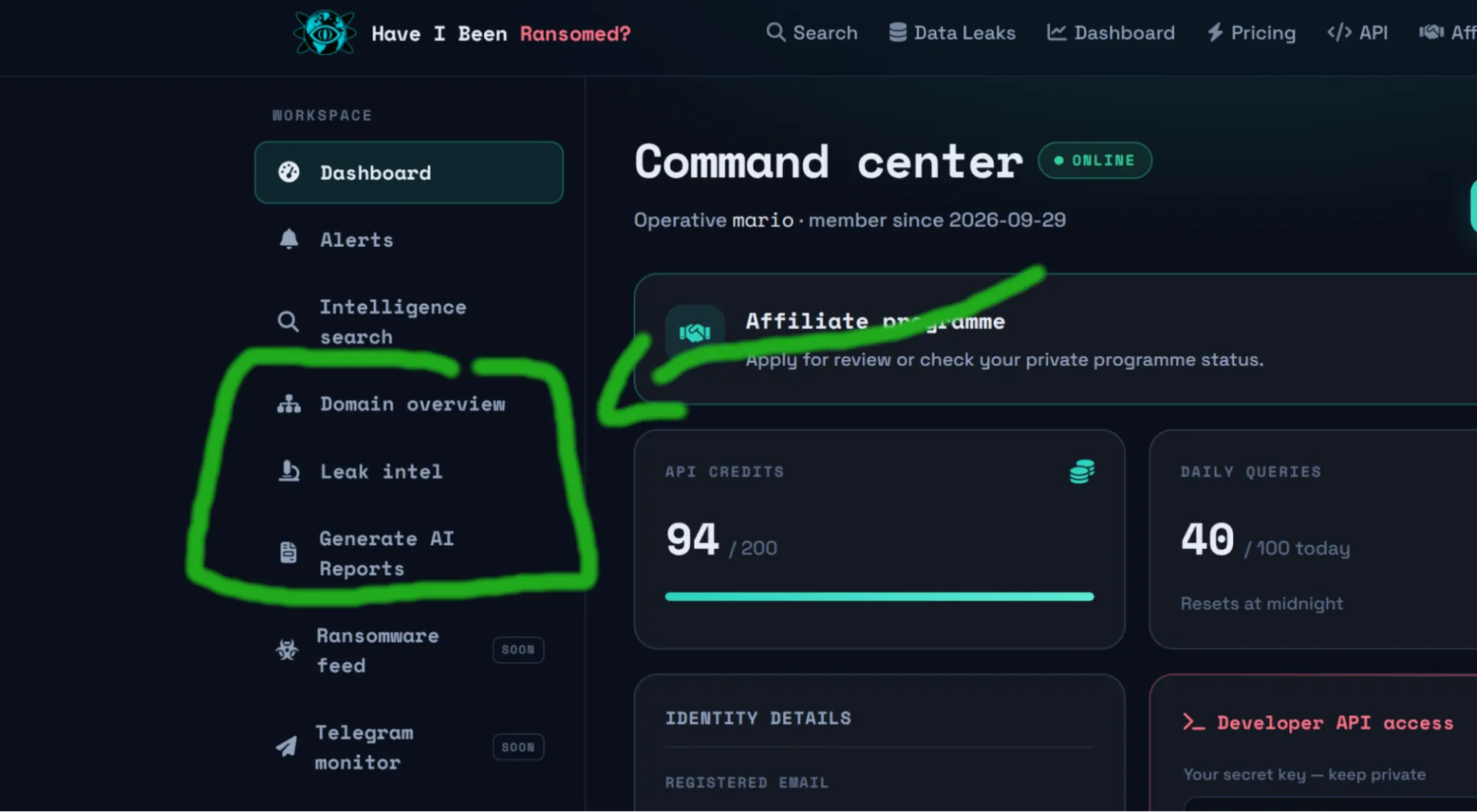
I've rarely seen a tool this powerful: the domain search feature in HIBR's control center offers complete visibility into the full scope of the incident and the target exposure. We can also use leak intelligence modules and generate a complete and confidential report with AI. Basically, right from the dashboard, you already have great tools to contain these shitty situations.
These well-labeled datasets exist thanks to a well-architected system behind the scenes. In order to help analysts handle dataleak chaos without losing their minds, the system brings together (behind the scenes) a streamlined operational architecture: besides automated crawlers, it deploys specific file classifiers, local LLMs and vision models, optimized semantic storage,and a solid reporting interface to keep teams sane.
Since data leaks are notoriously messy and physical documents in ransomware dumps are often crumpled, rotated, or photographed in poor lighting, local multimodal models can resolve unclear or hidden characters, boosting extraction accuracy by 22.4% over standard OCR and reaching a 99.54% precision rate on personal ID numbers.
The crawler interface tracks active extortion countdowns across threat actors (such as Play, Spirals, Gammax, AuditTeam, to name a few)
The evidence collector captures site snapshots, extortion countdown clocks(e.g., 9d 21h 31m 01s remaining), and proof-file text counters in real time.
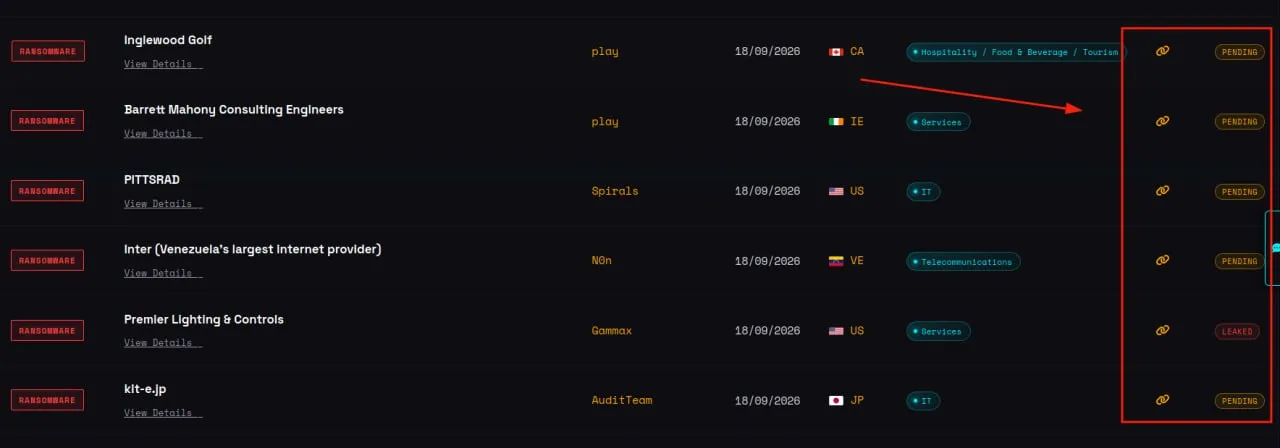
In targeted extortion cases breach.house tracks active ransom countdown timers, proof packs, and BitTorrent/aria2 magnet links in real time. By scraping initial proof files the instant a negotiation fails, defenders gain immediate visibility into targeted extortion material before it reaches public forums.
Crucially, these normalization routines don't just fix images: they apply to standard document formats (XLS, DOC, CSV, JSON) to ensure structural integrityacross the entire dataset.
The goal, however, isn't to drown in data, but to actually understand the incident and put the pieces back together correctly.
A few case studies that caught my interest - What's Really Inside the Leaks
The “Disney Internal Slack” leak:
While traditional aggregators stop at the leak's headline label ('Disney Slack') and understate its true impact, HIBR’s deep record-level analysis reveals what’s actually inside: a goldmine of HR workforce tables and IT permission registers primed for advanced social engineering attacks. By exposing that 71.4% of the dump consists of CSV files, over 76% of checked internal records contain employee scheduling data, and less than 2% of records even reference 'Slack', HIBR turns the noise of stolen data into actionable threat intelligence.
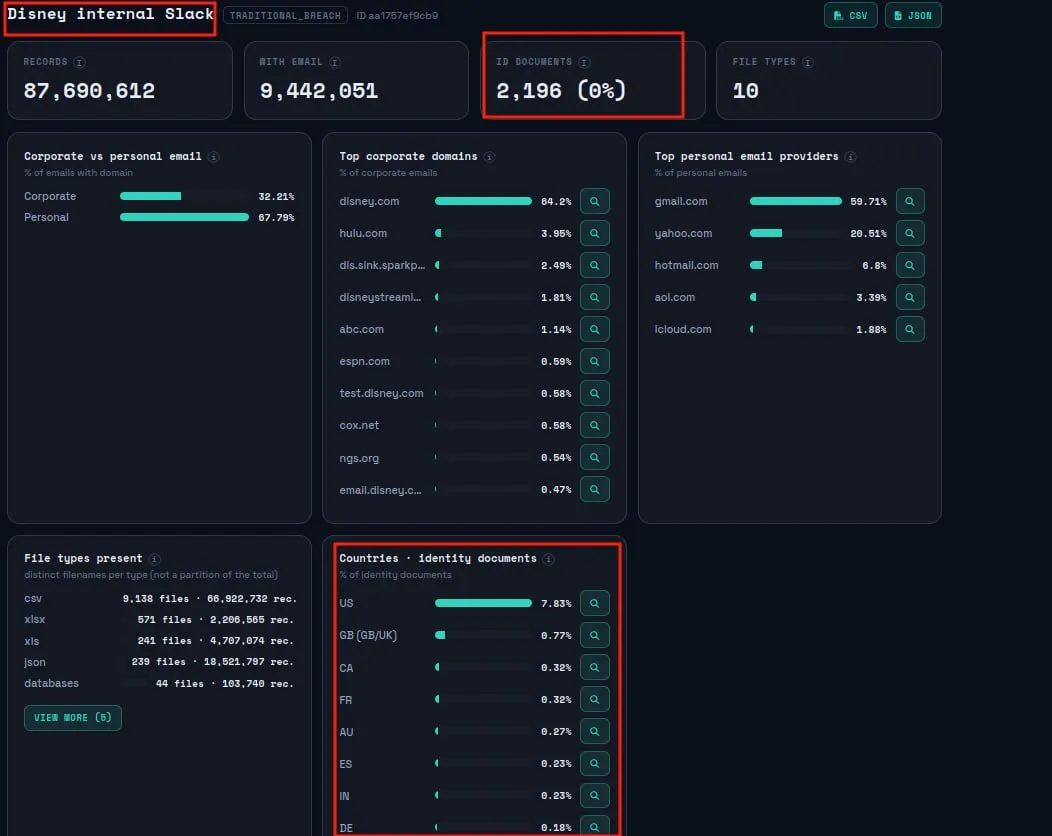
The primary risk wasn't informal office chat: it was an operational blueprint for targeted social engineering, authority impersonation, and internal credential fraud.
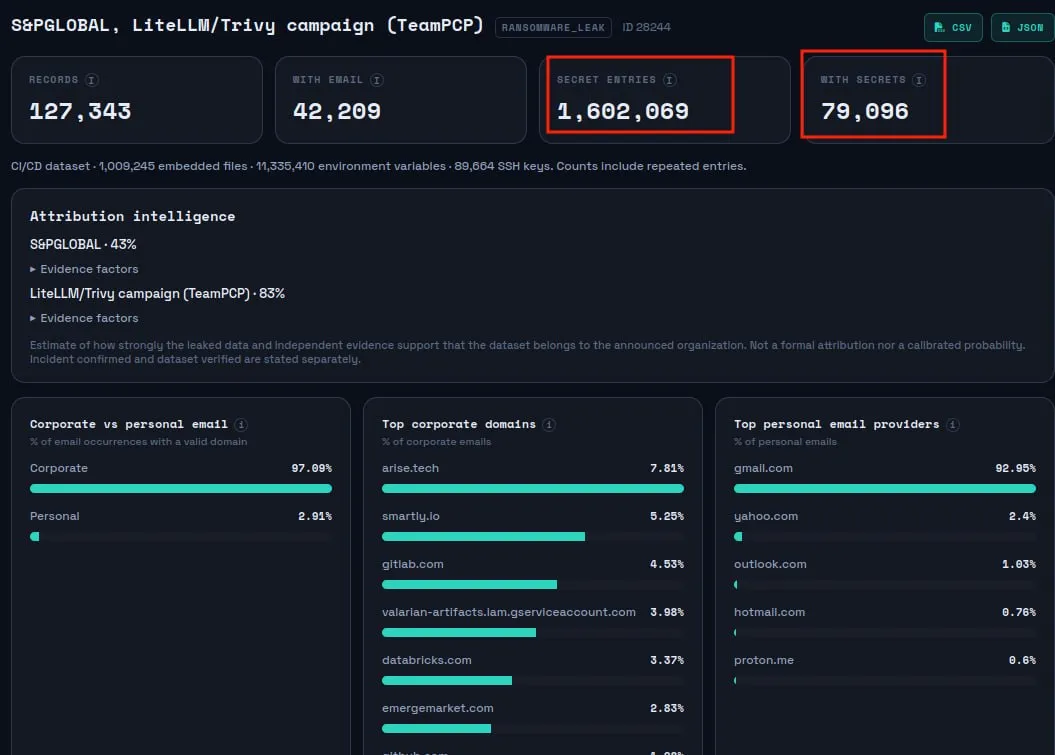
Take the S&P Global / LiteLLM-Trivy campaign leak as another prime example:
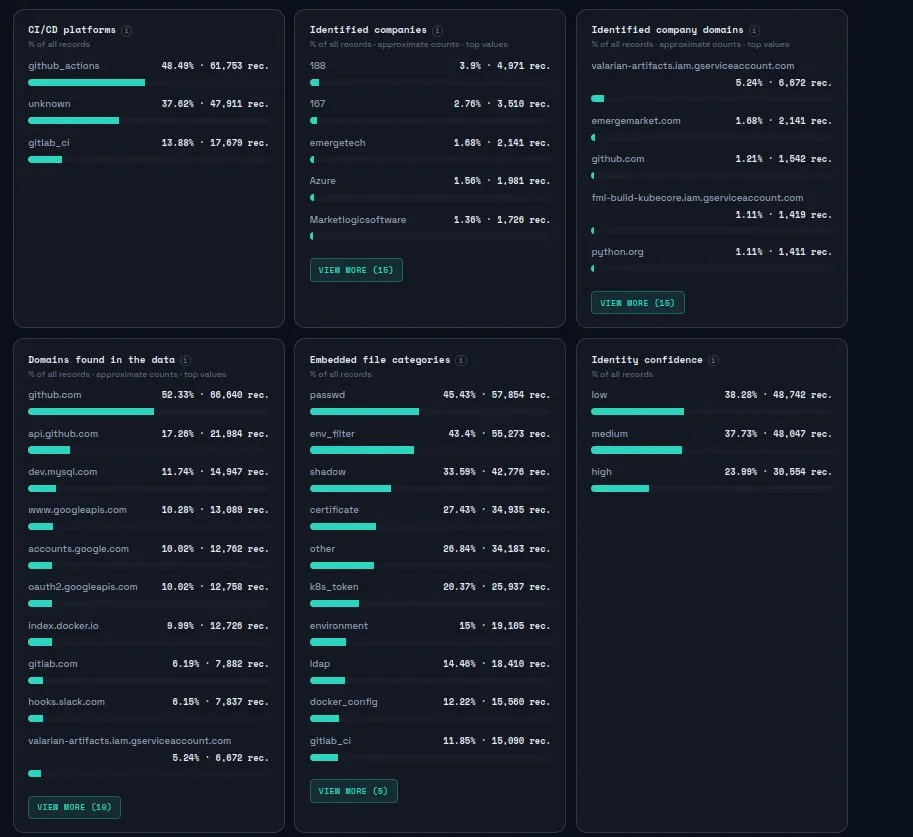
A standard threat intel platform would simply tag this as an 'S&P Global data breach' and move on. But HIBR's deep record analysis revealed a completely different reality: only 0.27% of the records actually matched S&P Global.
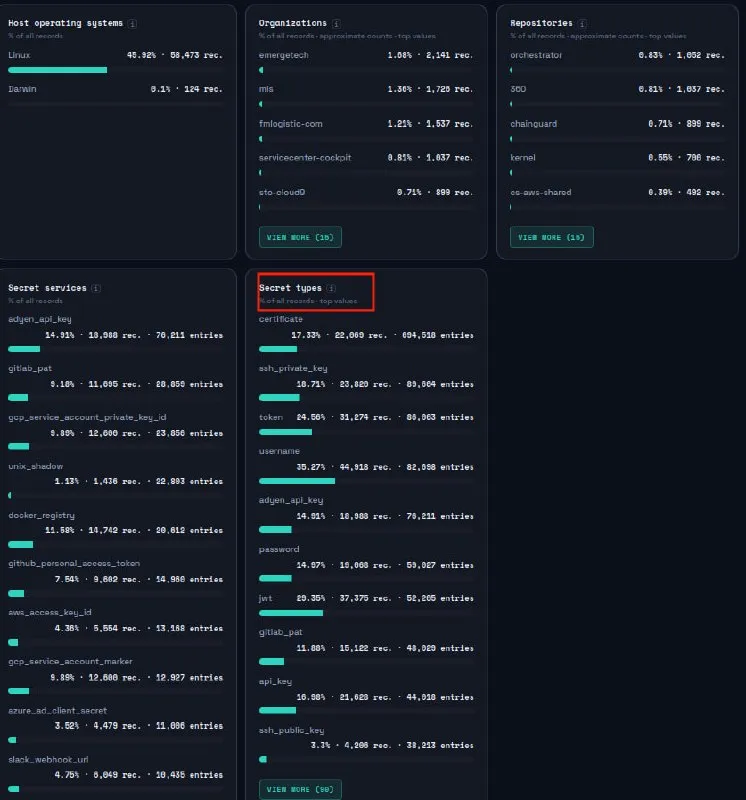
Instead of a single corporate breach, HIBR identified an automated supply-chain campaign harvesting CI/CD pipelines across over 78 distinct companies. Rather than stolen customer emails (97% of addresses were corporate Git developer identities), the dump was packed with live environment secrets: up to 47.1% of checked runner records contained private SSH keys, alongside thousands of GitHub tokens and AWS credentials.
Another case: ZenBusiness Breach
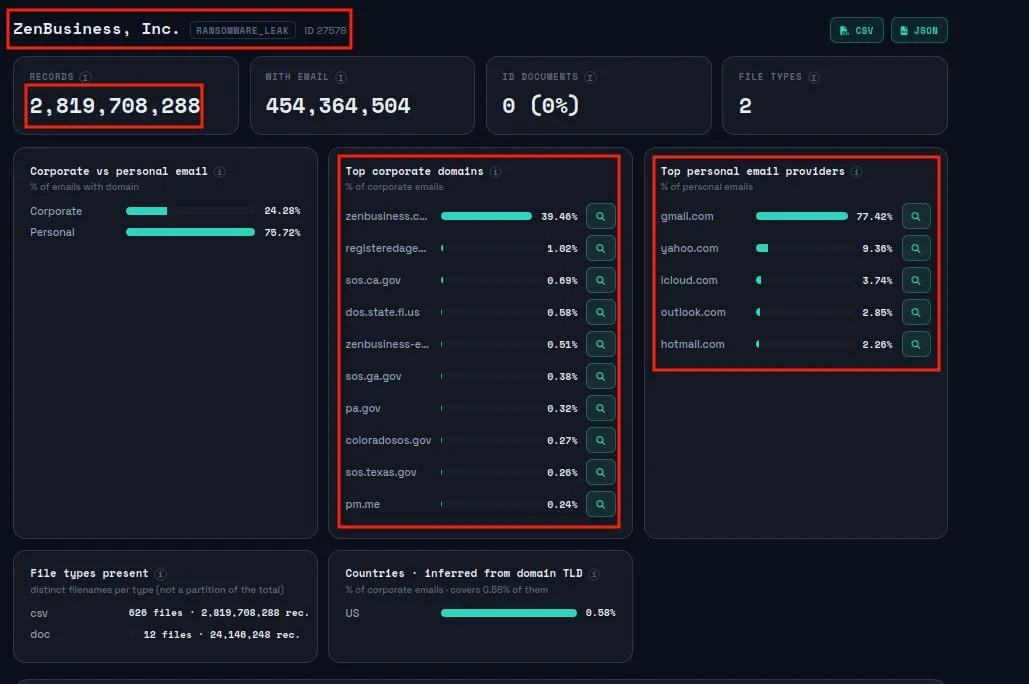
Finally, look at the ZenBusiness breach. Traditional indexing tools saw a massive dataset, over 2.8 billion total records, scanned the 16.1% of records containing email addresses, and slapped a predictable label on it: "ZenBusiness customer list leaked."
Case closed, right? Not even close.
The solution developed by Darkeye opened the hood and found that 99.15% of the data consisted of raw Fivetran-synced warehouse tables. More importantly, they uncovered a massive, emerging risk category that basic scrapers completely missed: 12.1% of the analyzed records were raw LLM interaction logs.
We aren't talking about basic CRM metadata here. These tables laid bare complete user prompts submitted to internal AI tools, prompt IDs, model parameters, token counts, and full model responses. In their rush to count email addresses, basic aggregators completely overlooked the fact that proprietary business logic, internal workflows, and confidential AI conversations were floating around in plain text.
Even the attribution score tells a deeper story. A naive tool might flag a partial match (61/100) and dismiss the leak, since corporate addresses are a minority of the dataset. Three in every four emails (75.72%) are personal, and Gmail alone accounts for 77.42% of those. An advanced platform accounts for real-world context: in a customer warehouse, the records should belong to customers, not internal staff. Rather than misinterpreting low employee counts as a false leak, we can get the exact nuance needed to read the data correctly.
Start small, for free, on a leak you already know
If you work on incidents, or simply follow leaks as part of your research, the best way to judge these tools is to run them on a case you already know. Pick a leak you are tracking, open it in the search, and compare what the platform shows with what the headline claimed.
You don't need a contract to start. Checking whether your email, phone, wallet or Telegram data appears in ransomware leaks, infostealers or breaches takes no signup and stays anonymous. Journalists, NGOs and universities can also apply for free Community Access, which is an easy way to test the approach on real material. On the infostealer side, raw files, wallets and Telegram data are connected across leaks, with 17 searchable fields. Webhooks and domain reports are part of the picture as well. Group profiles go further, with MITRE ATT&CK-mapped techniques, tracked crypto wallets and real ransom notes, so you can see how a group operates, not just that it hit someone.
We need to be aware that evaluating a modern data breach purely by counting text occurrences and lazy OCRs gives us an incomplete view.
Sure, plenty of organizations are gearing up (or already equipped) with solid, cutting-edge solutions, but they come with eye-watering price tags.
The good news? We’re dramatically cutting those costs down, and tools like the ones I’ve laid out can offer a genuinely effective, sustainable alternative.
The bad news? Threat actors will continue to dump complex data warehouses, compromise build environments, exfiltrate HR infrastructure, and leak raw AI logs, and they sure as hell aren't going to organize them neatly for us.
So maybe it's time to take control of the situation with better tools/platforms equipped with modern analytical capabilities built for today's tech, because attackers are using them... of course they do.
The only question is: do we want to keep giving them that head start?